
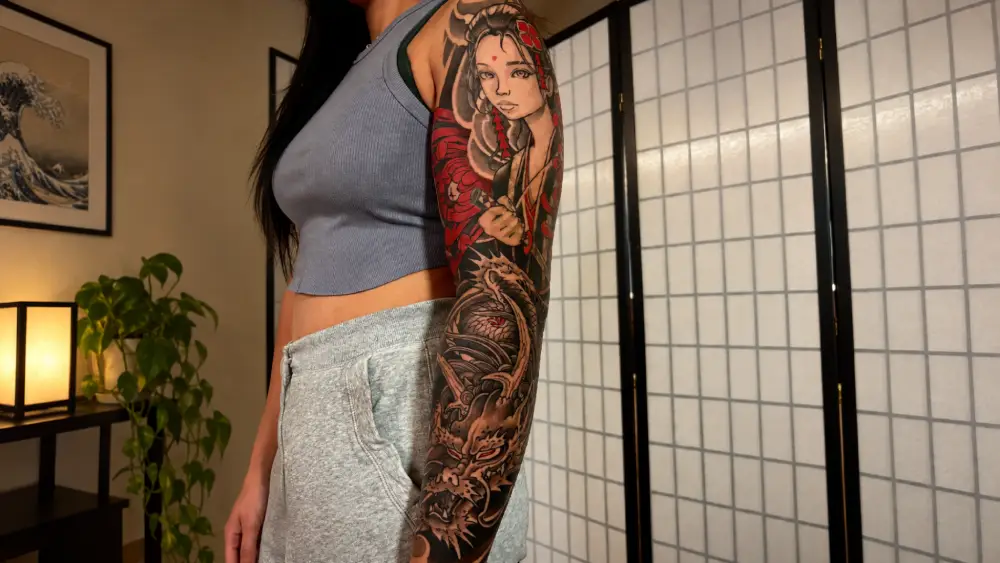
Choosing a tattoo is not just about finding an image you like. It is about making a series of connected decisions: what the tattoo represents, what visual language fits that idea, how it will work on your body, and whether it will still feel like you years from now.
At 18b Tattoo, we encourage clients to think beyond “What should I get?” The better question is: What kind of tattoo experience and result am I trying to create?
Here are the considerations that often lead to those “I never thought about that” moments.
Don’t Start With the Image. Start With the Feeling.
Most people begin by searching for a subject: a snake, flower, name, skull, butterfly, date, or quote. That can be helpful, but it may also send you down an endless scroll of designs that all look disconnected.
Instead, begin with the feeling you want the tattoo to carry.
Do you want it to feel:
- Quiet and personal?
- Powerful and dramatic?
- Playful and unexpected?
- Romantic?
- Protective?
- Mysterious?
- Clean, minimal, and understated?
- Visually bold from across the room?
This changes the entire selection process. A tattoo about resilience, for example, could be a delicate branch, a large blackwork design, a handwritten phrase, or an abstract composition. The subject may differ completely, but the feeling is what makes the piece feel right.
You may not be attached to the image itself — you may be attached to what you want the image to make you feel.
Pay Attention to the Difference Between “I Like It” and “I Want to Wear It.”
You can love a tattoo on someone else and still not want it on your own body.
This is one of the most important distinctions in tattoo selection. A design may look incredible online, fit another person’s style perfectly, or be beautifully executed — but that does not automatically mean it belongs in your personal collection.
Ask yourself:
- Do I like this as artwork, or do I want it to become part of my appearance?
- Does this feel consistent with how I dress, decorate, and express myself?
- Would I want to see this on my body regularly?
- Does it feel like a phase, or like a visual preference I return to naturally?
A tattoo becomes part of how you see yourself. That does not mean every tattoo needs to be serious. It means the design should feel wearable, not just impressive.
Build a Reference Collection — Then Edit It Ruthlessly.
Inspiration is useful, but a large folder of saved images is not the same thing as a clear tattoo idea.
Start by saving anything that genuinely catches your eye: tattoos, art, photographs, typography, textures, colors, symbols, clothing details, architecture, album art, or vintage illustrations. Then, after you have collected enough, look for repetition.
You may notice that your saved images repeatedly include:
- Soft black-and-grey shading
- Heavy black outlines
- Delicate botanical details
- Symmetrical layouts
- Strange surreal objects
- Organic curves rather than sharp geometry
- Fine lettering
- Bright color
- Dark, high-contrast imagery
The goal is not to find one image to replicate. The goal is to identify your visual instincts.
Next, remove anything you saved only because it was trendy, technically impressive, or popular. What remains is usually a much clearer guide to the tattoo you actually want.
Your inspiration folder may be telling you that you have a style preference you never consciously identified.
Choose the Tattoo’s “Job.”
Not every tattoo needs to do the same thing. Some tattoos are designed to be noticed. Others are designed to be discovered. Some are meant to stand alone, while others are meant to become part of a larger collection over time.
Before selecting a design, decide its job:
- Is this a focal-point tattoo that should command attention?
- Is it a small personal detail?
- Is it the beginning of a sleeve, leg piece, or larger body of work?
- Is it meant to balance tattoos you already have?
- Is it a gap-filler or supporting piece?
- Is it intended to be read from a distance or appreciated up close?
This matters because a tattoo designed to be a centerpiece requires different choices than one meant to complement existing work.
For example, a tiny detailed design may be beautiful on its own, but it may disappear visually next to large, high-contrast tattoos. On the other hand, a bold design may overpower an area if you were hoping to keep space for future pieces.
Think About Your Body as a Canvas, Not a Flat Page.
A tattoo design is not viewed on a flat screen. It wraps, bends, moves, and changes depending on the part of the body where it is placed.
This is why placement should be part of the design conversation from the beginning.
A straight, symmetrical design may look perfect on paper but require adjustment to sit naturally on a curved shoulder or around an elbow. A design with movement — such as a snake, vine, dragon, or flowing script — can be especially effective when it follows the body’s natural lines.
Consider:
- Direction: Should the tattoo move vertically, horizontally, or around the body?
- Flow: Does it follow the natural curve of the placement?
- Viewing angle: Will you see it often, or is it primarily outward-facing?
- Motion: How might the design change visually when you bend your arm, sit, walk, or turn?
- Space around it: Will it have room to breathe, or is it competing with other tattoos?
The “right” design can look wrong in the wrong location — and an ordinary design can become exceptional when it is designed for its placement.
Decide What Must Be Exact — and What Can Stay Flexible.
Many people arrive with a very specific idea. Others have only a mood board and a general direction. Both approaches can work, but it helps to know which details are non-negotiable.
For example, you may know with certainty that you want:
- A specific phrase
- A particular date
- A meaningful symbol
- A family reference
- A certain animal or flower
- A tattoo in a particular location
Everything else may be open to exploration: style, composition, size, framing, line weight, or level of detail.
Knowing the difference between your essentials and your flexible choices makes it easier to collaborate. It also prevents you from becoming attached to a reference image before considering whether it is the best version of your idea.
Select for Longevity, Not Just for Today’s Screenshot.
Tattoo designs change over time. Fine lines may soften, small details may become less distinct, and closely spaced elements may visually merge as the ink settles into the skin.
That does not mean you must avoid detail, small tattoos, or delicate work. It means the tattoo needs to be designed with its future in mind.
When choosing a design, think about:
- Whether tiny details have enough room to remain distinct
- Whether lettering is large enough to stay readable
- Whether high contrast is needed for the design to remain visible
- Whether a small design should be simplified rather than squeezed
- Whether the idea needs a larger scale to achieve the look you want
A skilled tattoo artist can help translate your concept into a design that works not only on the day it is tattooed, but as it becomes part of your skin over time.
Treat the Consultation as Part of the Selection Process.
A consultation is not simply a step before booking. It is where a good idea becomes a tattoo that works.
Bring references but also bring context. Explain what you connect with in the images: the mood, the layout, the shading, the line work, the symbolism, or the way the tattoo fits the body. This is far more helpful than saying, “I want this exact tattoo.”
A productive conversation can reveal things you may not have considered:
- Your favorite reference may be too detailed for the size you imagined.
- Your chosen placement may work better with a rotated or restructured design.
- Multiple references may point toward a custom concept rather than one existing image.
- A slightly larger design may give the tattoo far more clarity and impact.
- The tattoo may work best as part of a future larger composition.
Those are not compromises. They are the decisions that turn an idea into a thoughtful, well-designed tattoo.
Start With an Idea. Leave With a Direction.
The selection process should feel exciting, not overwhelming. You do not need to arrive with a finished design — but you should arrive ready to explore what you want your tattoo to say, how you want it to feel, and where it belongs.
Ready to turn your inspiration into a tattoo that feels unmistakably yours? Connect with 18b Tattoo to begin the conversation.